Common Physics Preparation Myths That Are Hurting Your JEE/NEET 2027 Rank
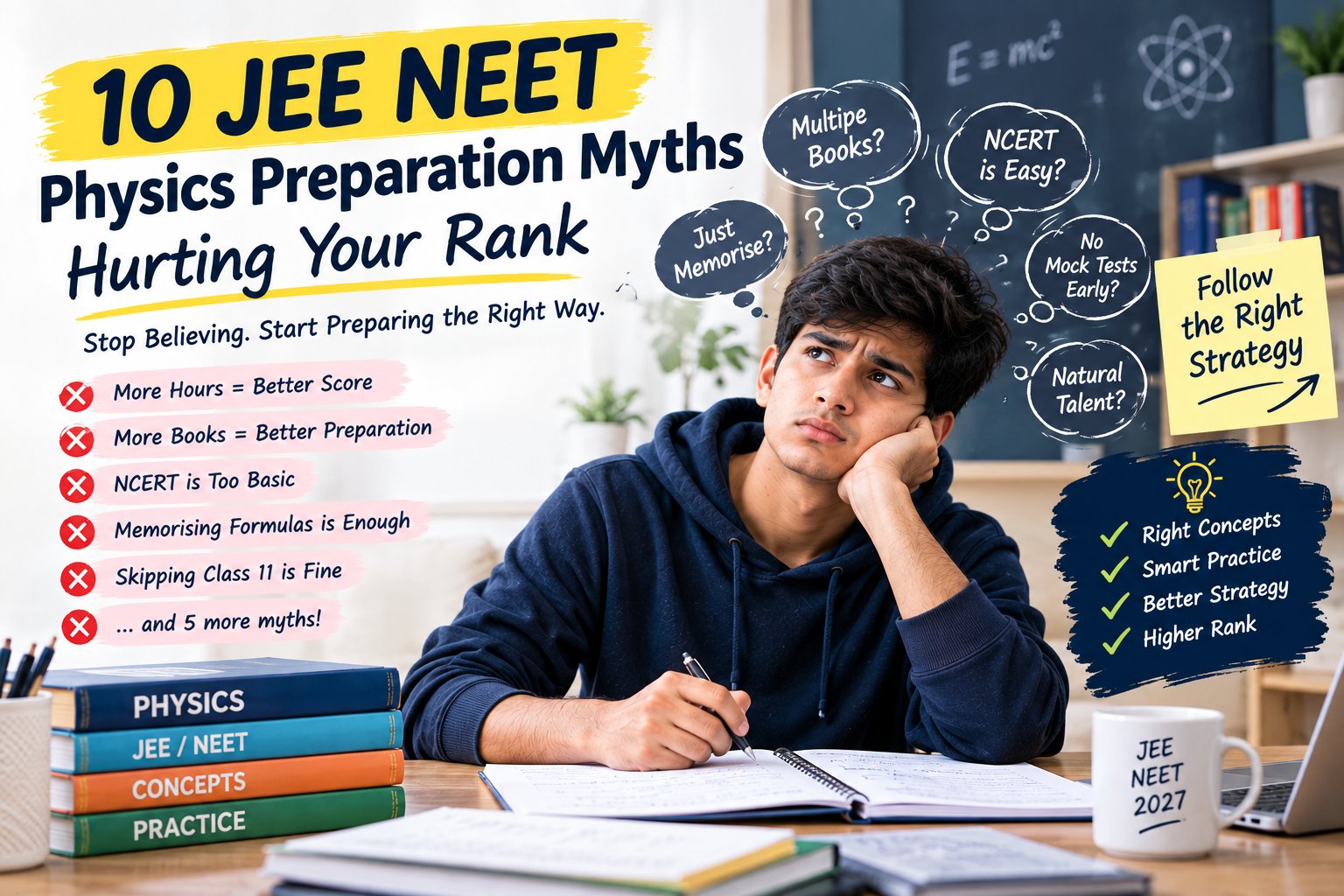
Every year, lakhs of students prepare sincerely for JEE and NEET.
They study for hours. They solve problems. They attend classes. They genuinely work hard.
And yet a large number of them do not get the Physics score their effort deserves.
The reason is rarely laziness. More often, it is JEE/NEET physics preparation myths, widely believed ideas about how to study Physics that sound logical but are actively hurting your rank.
We have worked with thousands of JEE and NEET aspirants at BestPhysicsTeacher.com. The same myths come up again and again. Students believe them, build their preparation around them, and then wonder why Physics is not clicking.
This blog busts the 10 most damaging JEE NEET physics preparation myths and tells you exactly what to do instead.
Related: Effective Study Strategies for Physics Exams
Myth 1 — "More Hours of Study Means Better Physics Score"
This is the most common JEE NEET physics preparation myth and the most damaging.
Students often measure preparation quality by hours. Eight hours of Physics daily sounds impressive. But if those eight hours are spent passively watching lectures, copying notes without thinking, or re-reading theory without solving problems, they deliver almost nothing.
The truth: JEE and NEET Physics rewards focused, active study, not extended passive study.
Two hours of genuinely solving previous year problems, analysing wrong answers, and clearing specific doubts will consistently outperform six hours of passive note-copying. Quality of engagement matters far more than total time.
What to do instead: Track what you produce per hour: problems solved, doubts cleared, concepts tested. Not hours sat at a desk.
Myth 2 — "Solving More Books Means Better Preparation"
Walk into any JEE aspirant's room. You will find 4 to 6 Physics books. HC Verma. DC Pandey. Irodov. SL Arora. Physics Galaxy. Most of them are barely touched beyond Chapter 3.
This is one of the most expensive JEE NEET physics preparation myths in existence.
The truth: Finishing one book is worth more than starting five.
When students spread across multiple books, they get fragmented knowledge with dangerous gaps. A chapter half-studied from Book A and half-studied from Book B creates confusion, not clarity.
According to consistent data from JEE toppers, one primary book studied deeply, cover to cover, is the correct approach. For Physics, HC Verma for concepts and DC Pandey for JEE Main level practice is enough for most aspirants. Add Physics Galaxy only if you are targeting JEE Advanced top 500.
What to do instead: Choose one primary book. Finish every exercise, every example, every miscellaneous problem. Then and only then supplement specific weak chapters from a second source.
Myth 3 — "NCERT is Too Basic for JEE Physics Skip It"
This is one of the most expensive JEE NEET physics preparation myths we encounter.
Many JEE aspirants skip NCERT Physics entirely, believing it is too simple for competitive exam preparation. This is a costly mistake.
The truth: NCERT Physics is the foundation that makes everything else work.
JEE Main Physics 2026 had multiple questions directly based on NCERT in-text examples and chapter exercises. NEET Physics is almost entirely NCERT-driven; students who skip NCERT and go straight to advanced books are essentially building on sand.
Skipping NCERT does not make you more prepared for JEE. It leaves conceptual gaps that advanced problem-solving cannot fill.
What to do instead: Read NCERT Physics cover to cover first. Solve every in-text example. Mark every definition, every derivation, every figure. Then move to HC Verma or DC Pandey with that foundation in place.
Related: NEET Physics Syllabus 2027 — Complete Chapter List
Myth 4 — "Memorising Formulas is the Same as Understanding Physics"
This is perhaps the most widespread JEE NEET physics preparation myth, and it is the one that breaks students in JEE Advanced specifically.
Students build formula sheets, memorise them thoroughly, and feel prepared. Then JEE Advanced gives them a question they have never seen before, and the formula sheet is useless because they never understood where the formulas came from.
The truth: Formula memorisation without conceptual understanding is preparation for JEE Main at best, not JEE Advanced or NEET application questions.
A formula you cannot derive is a formula you will forget under exam pressure. A formula you understand deeply is one you can reconstruct even if it slips your memory.
According to JEE 2026 topper analysis, students who scored 90 plus in Physics consistently reported understanding derivations, not just memorising results.
What to do instead: For every formula you study, understand its derivation, its physical meaning, and the exact conditions under which it applies. This takes longer but produces understanding that holds up under real exam pressure.
Myth 5 — "Skipping Class 11 Physics Chapters is Fine for NEET"
Many NEET aspirants treat Class 11 Physics as optional. They focus almost entirely on Class 12 chapters Electrostatics, Optics, Modern Physics and treat Mechanics as something they can skim.
This is a dangerous JEE/NEET physics preparation myth that costs NEET aspirants 20 to 30 marks every year.
The truth: Class 11 Physics contributes approximately 40 to 45% of NEET Physics marks every year.
NEET 2026 Physics paper had strong representation from Laws of Motion, Rotational Motion, Work-Energy-Power, and Thermodynamics all Class 11 chapters. Students who had skipped or surface-studied these chapters lost marks they had no way to recover.
What to do instead: Give Class 11 Physics equal time and respect as Class 12. Mechanics Laws of Motion and Rotational Motion specifically must be thoroughly prepared, not skimmed.
Myth 6 — "Mock Tests Are Only for the Last 2 Months"
We hear this JEE NEET physics preparation myth constantly.
Students plan to study the full syllabus first, then start mock tests in the final two months before the exam. This approach almost always produces disappointing results.
The truth: Mock tests are a learning tool, not just an assessment tool. Starting them late means you lose months of the most powerful learning mechanism available.
Mock tests reveal your actual weak areas, not the ones you think are weak. They build exam temperament under time pressure. They train you to make decisions quickly. All of this takes time to develop.
JEE and NEET toppers consistently start chapter-wise mock tests from the early months of preparation, not the final stretch.
What to do instead: Start chapter-wise mini tests from Month 2 of preparation. Start full-length subject-wise tests from Month 5. Start complete mock tests from Month 7. By the final 2 months, you should be analysing test performance, not taking your first full mock.
Myth 7 — "Physics is About Natural Talent Either You Get It or You Don't"
This is one of the most damaging JEE NEET physics preparation myths because it makes students give up before they have genuinely tried.
The truth: Physics performance in JEE and NEET is almost entirely a function of teaching quality, study method, and consistent practice, not natural talent.
Analysis of NEET 2025 and 2026 toppers in Physics consistently shows one pattern: students who scored 160 plus in Physics had access to a teacher who built concepts from first principles. Students who scored below 100 typically reported surface-level teaching and formula memorization as their primary method.
Natural talent determines nothing. The teaching method and preparation approach determine everything.
What to do instead: If Physics has always felt difficult, the problem is almost certainly your previous teaching or study method, not your intelligence. Find a teacher who builds from first principles and gives concepts the time they need.
Myth 8 — "Following Multiple Teachers Gives You a More Complete Preparation"
In the age of YouTube, this JEE NEET physics preparation myth has become increasingly common.
Students follow 3 to 4 different YouTube teachers for Physics simultaneously, one for Mechanics, one for Electrostatics, one for Modern Physics. Each teacher uses a slightly different notation, different formula arrangement, and different problem-solving approach.
The truth: Following multiple teachers creates confusion, not completeness.
When different teachers use different notations and different approaches to the same chapter, students end up with fragmented understanding and no consistent logical framework. This fragmentation surfaces most painfully in multi-concept JEE Advanced questions and NEET paper analysis.
What to do instead: Choose one primary Physics teacher for your complete preparation. Their approach, their notation, their problem-solving method becomes your framework. You can refer to additional resources for specific doubts, but the primary framework must be consistent.
Myth 9 — "Revision is Just Re-Reading Notes Before the Exam"
Many students plan one big revision session in the final 2 weeks before JEE or NEET. They re-read their notes, go through formula sheets, and consider themselves revised.
This is a JEE/NEET physics preparation myth about how memory actually works.
The truth: Effective revision is spaced, active, and chapter-specific, not a last-minute passive re-read.
Research consistently shows that spaced repetition, revisiting content at increasing intervals, is dramatically more effective than massed re-reading before an exam. Physics concepts and formulas that are not actively revised every 2 to 3 weeks will fade.
Students who revise continuously throughout their preparation arrive at the exam with sharp, accessible memory. Students who revise only in the final 2 weeks arrive overwhelmed and under-prepared.
What to do instead: Schedule a weekly revision session every Sunday revisiting all chapters completed in the previous month. This 1- to 2-hour weekly investment keeps everything fresh without requiring a last-minute panic revision.
Myth 10 — "Switching to a Different Teacher Will Instantly Fix Everything"
This is the JEE NEET physics preparation myth that affects droppers and Class 12 students who are disappointed with their progress.
When results are not improving, switching teachers feels like the obvious solution. Some students switch 2 to 3 times in a single preparation year.
The truth: Switching teachers mid-preparation almost always makes things worse before it makes them better.
Every teacher has a different notation system, different chapter sequencing, different problem-solving language. Switching resets your conceptual framework and creates gaps in topics covered during the transition period. The energy spent adjusting to a new teacher is energy not spent on actual preparation.
What to do instead: Before switching, honestly diagnose whether the problem is the teacher or the study method. If the teacher genuinely lacks conceptual depth, switching is necessary. But if the issue is your own consistency, switching will not help. If you do switch, do it at the start of a new topic cluster not mid-chapter.
Our Recommendation
At BestPhysicsTeacher.com, we evaluate physics teachers based on one core question: do they bust these myths by design, or do they perpetuate them?
The best teachers build understanding not formula memorization. They use one consistent framework. They make students derive, not just recall.
Here are our three recommended teachers for JEE and NEET 2027:
Hitesh Gupta — Senior Physics Faculty at ALLEN Kota. His first-principles approach directly addresses Myths 4, 7, and 8 above. Students never memorize without understanding in his classes.
**View Profile — Hitesh Gupta**
Rahul Singh — NIT Trichy graduate with strong problem-solving methodology. Addresses Myth 1 and Myth 6 his practice-first, analysis-heavy approach builds the exam temperament that JEE and NEET demand.
**View Profile — Rahul Singh**
Nishant Gautam — MNIT Jaipur graduate with structured, beginner-friendly teaching. Addresses Myth 3 and Myth 5; NCERT-first, Class 11 respected, concept always before formula.
**View Profile Nishant Gautam**
**Compare all teachers at BestPhysicsTeacher.com**
Conclusion
JEE NEET physics preparation myths are not harmless misunderstandings.
They are active preparation errors that cost students marks, ranks, and in some cases their target college.
Every myth on this list is believed by thousands of students right now. Some of them will read this blog and change their approach. Others will not and will wonder why their effort is not translating into results.
The students who rank well in JEE and NEET Physics in 2027 are not necessarily the ones who study the most hours. They are the ones who study with the right method, the right teacher, and without these myths sabotaging their preparation.
Check your own preparation against every myth above. Be honest about which ones you have been believing. And fix them now, while there is still time before JEE Main and NEET 2027.
For expert guidance on JEE and NEET Physics preparation, visit BestPhysicsTeacher.com
Frequently Asked Questions
The most damaging myth is that memorising formulas equals understanding Physics. JEE Advanced and NEET 2027 both test application of concepts not formula recall. Students who understand derivations consistently outperform those who only memorize.
NCERT is the essential foundation not the complete preparation. For JEE Main, NCERT plus HC Verma and DC Pandey covers most of the syllabus. For JEE Advanced, Physics Galaxy or Irodov is additionally needed. But NCERT must never be skipped.
For JEE Main: HC Verma for concepts and DC Pandey for practice is sufficient for most students. For JEE Advanced, add Physics Galaxy. For NEET: NCERT is primary and DC Pandey Objective Physics for MCQ practice. One book finished completely beats five books started but not completed.
Start chapter-wise mini tests from Month 2 of preparation. Full Physics subject tests from Month 5. Complete 3-subject mock tests from Month 7. Do not wait until the final 2 months by then it is too late to benefit from what mock tests reveal.
No. Physics performance is almost entirely determined by teaching quality and study method, not natural aptitude. If Physics has always been difficult, the root cause is almost always how it was taught or how it was studied, both of which are fixable.