Chapter-wise Weightage Trend: Last 5 Years JEE Physics Analysis
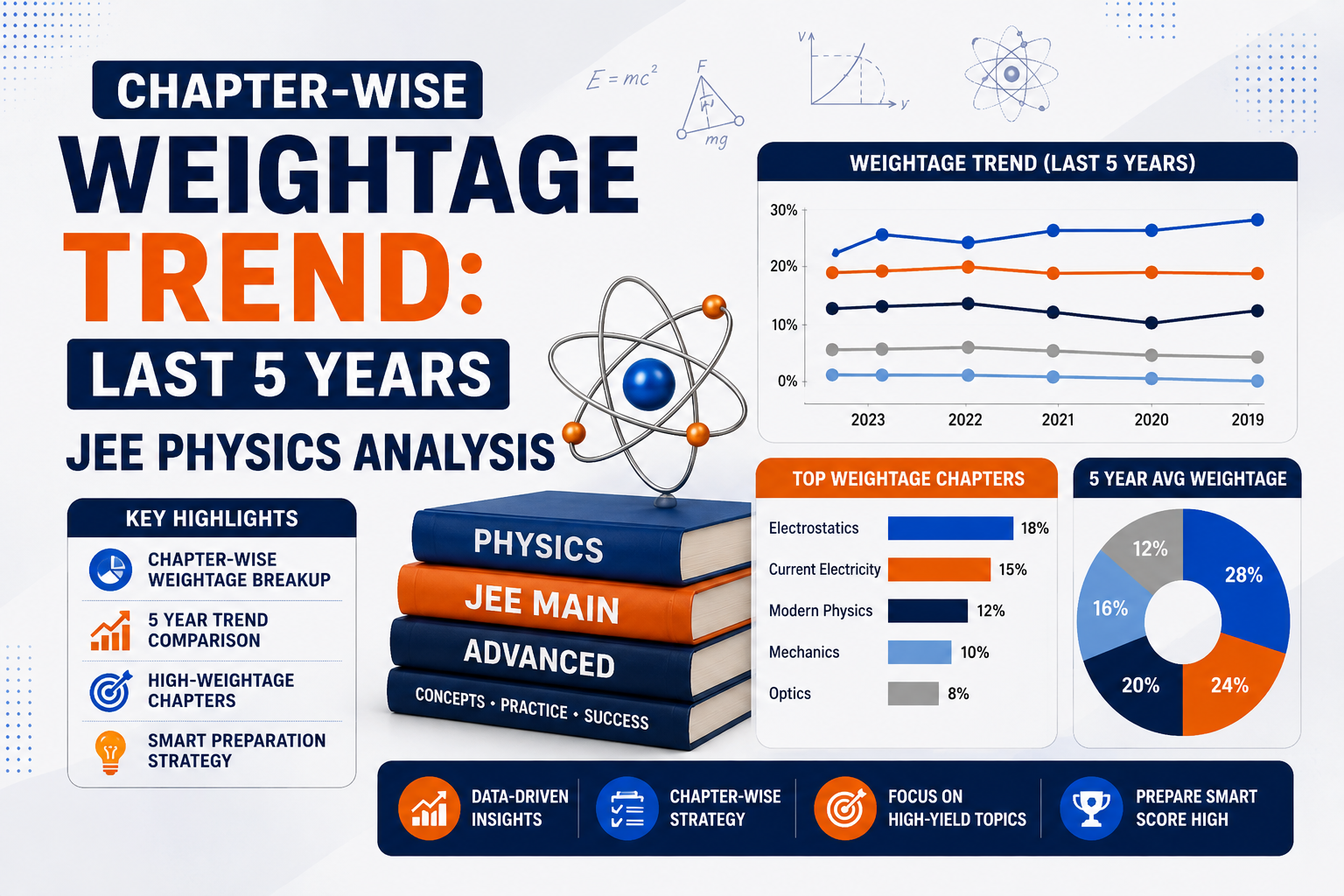
Every JEE aspirant eventually asks the same question: "Which Physics chapters should I actually prioritize?" The syllabus has close to 30 chapters, but not all of them carry equal weight in the exam. Some chapters show up in almost every session; others barely make an appearance.
This blog breaks down the actual chapter-wise weightage trend in JEE Main Physics over the last five years (2021–2025), based on published PYQ (Previous Year Question) analysis and recent session data.
Use it to build a smarter, more targeted revision plan so you don't skip chapters entirely. If you haven't already, pair this with our guide on which JEE Physics chapters to skip or study for a more decision-ready view of the same data.
A quick disclaimer before we start: the NTA (National Testing Agency) does not officially publish chapter-wise marks distribution. Every weightage table you see anywhere online, including this one, is derived by analysing actual previous year papers, question-by-question. That makes this data a reliable trend indicator, not a guarantee of what will appear next session. Also worth checking: if any chapters have been added, dropped, or modified since these papers were set, our JEE Physics syllabus changes breakdown covers exactly that.
Physics Weightage in the Overall JEE Main Paper
Before diving into individual chapters, here's where Physics sits in the exam structure:
| Detail | Value |
|---|---|
| Total Physics questions | 25 (20 MCQs + 5 Numerical) |
| Questions to attempt | 25 (all compulsory) |
| Total Physics marks | 100 out of 300 |
| Share of overall paper | ~33% |
| Marking scheme | +4 for correct, −1 for each wrong answer |
Physics contributes a full third of your JEE Main score, which is exactly why a scattered, unplanned approach to it costs students the most marks.
JEE Main Physics: 5-Year Chapter-wise Weightage (2021–2025)
Based on the aggregated PYQ analysis of JEE Main sessions from 2021 to 2025, here is how individual chapters have performed:
| Rank | Chapter | Approx. Weightage |
|---|---|---|
| 1 | Current Electricity | 6.5–9.9% |
| 2 | Ray Optics & Optical Instruments | 5.0–6.6% |
| 3 | Semiconductor Electronics | 4.7% |
| 4 | Gravitation | 4.5% |
| 5 | Electrostatic Potential & Capacitance | 4.5% |
| 6 | Rotational Motion | 4.3–6.6% |
| 7 | Units and Measurements | 4.2% |
| 8 | Dual Nature of Radiation and Matter | 4.0% |
| 9 | Alternating Current | 3.7–6.6% |
| 10 | Oscillations (SHM) | 3.3% |
| 11 | Electromagnetic Induction | 3.3% |
| 12 | Electric Charges and Fields (Electrostatics) | 3.2–3.3% |
| 13 | Nuclei | 3.1% |
| 14 | Thermodynamics + Kinetic Theory of Gases | 3.0–6.6% |
| 15 | Mechanical Properties of Fluids | 3.0% |
| 16 | Electromagnetic Waves | 3.0% |
| 17 | Motion in a Plane | 2.9% |
| 18 | Moving Charges and Magnetism | 2.9–6.6% |
| 19 | Motion in a Straight Line (Kinematics) | 2.6–6.6% |
| 20 | Centre of Mass & System of Particles | 2.6–6.6% |
| 21 | Atoms | 2.5% |
| 22 | Work, Energy and Power | 2.4–6.6% |
| 23 | Wave Optics | 2.3–6.6% |
| 24 | Mechanical Properties of Solids (Elasticity) | 2.1–3.3% |
| 25 | Thermal Properties of Matter | 2.1% |
| 26 | Newton's Laws of Motion | 2.1–6.6% |
| 27 | Waves (Sound) | 1.9–3.3% |
| 28 | Magnetism and Matter | 1.9% |
Note: Where two figures are shown, the lower number reflects standalone-chapter analysis, while the higher number reflects the combined weightage when the chapter is grouped with closely related topics (e.g., Kinematics + Laws of Motion + Rotational Dynamics are often clubbed as the "Mechanics" block in exam-pattern breakdowns).
The Big Takeaway: Mechanics Is the Real Heavyweight
No single Mechanics sub-chapter tops the individual list, but when you add up Kinematics, Laws of Motion, Work-Energy-Power, Rotational Dynamics, and Centre of Mass, Mechanics as a block contributes 5–6 questions per session, making it the single largest thematic group in Physics, bigger than Electrodynamics or Modern Physics taken individually.
JEE Main 2025: What Actually Got Asked (Real Session Data)
Aggregate 5-year data is useful, but the most recent sessions tell you where the exam is heading right now. Here's the chapter-wise question count from the January and April 2025 sessions:
| Chapter | Jan 2025 | April 2025 |
|---|---|---|
| Ray Optics and Optical Instruments | 23 | 19 |
| Units and Measurements | 20 | 13 |
| Fluid Mechanics | 16 | 10 |
| Rotational Motion | 14 | 13 |
| Electric Charges and Fields | 14 | 13 |
| Thermodynamics | 13 | 9 |
| Moving Charges and Magnetism | 12 | 12 |
| Dual Nature of Radiation and Matter | 12 | 7 |
| Work, Power and Energy | 11 | 4 |
| Semiconductor Electronics | 10 | 9 |
| Wave Optics | 10 | 9 |
| Current Electricity | 9 | 8 |
| Electrostatic Potential and Capacitance | 9 | 12 |
| Electromagnetic Waves | 9 | 5 |
| Thermal Properties of Matter | 8 | 5 |
| Gravitation | 8 | 6 |
| Kinetic Theory of Gases | 5 | 7 |
| Atoms | 5 | 7 |
| Alternating Current | 7 | 6 |
(Numbers represent cumulative counts across shifts within each session, not a single paper.)
What this tells you: Ray Optics and Units & Measurements have quietly overtaken Current Electricity as the single highest-frequency topics in the most recent sessions even though Current Electricity still leads in the 5-year aggregate. This is a good example of why checking recent trends alongside long-term averages matters.
Class 11 vs Class 12: Where Do the Marks Actually Come From?
A common myth is that JEE Main Physics leans heavily on Class 12 content. The real data says otherwise it's close to balanced, with a slight Class 12 edge:
| Session | Class 11 Questions | Class 12 Questions |
|---|---|---|
| Jan 2024 | 141 | 159 |
| April 2024 | 143 | 157 |
| Jan 2025 | 121 | 129 |
| April 2025 | 109 | 116 |
Roughly a 47:53 split in favour of Class 12, meaning Class 11 Mechanics, Thermodynamics, and Waves are still worth almost half your Physics score. Skipping Class 11 revision to "focus on Class 12" is one of the most common and costly mistakes droppers make.
Tier-wise Breakdown: How to Actually Use This Data
Instead of memorizing every percentage, group chapters into three tiers and allocate your prep time accordingly.
Tier 1: High Weightage (Prioritize First)
Current Electricity, Ray Optics & Wave Optics, Electrostatics & Capacitance, Rotational Dynamics, Modern Physics (Dual Nature + Atoms + Nuclei), Semiconductor Electronics, Units & Measurements.
Tier 2: Moderate but Consistent
Thermodynamics, Kinetic Theory of Gases, Magnetism (Moving Charges + Magnetism and Matter), Alternating Current, Gravitation, Electromagnetic Induction, Oscillations.
Tier 3: Lower Frequency but Not Skippable
Semiconductors (basic level), Sound Waves, Elasticity, Circular Motion, Electromagnetic Waves, Errors in Measurement. Together these still contribute around 5–6 questions (20–24 marks) enough to change your rank by thousands of positions.
A Practical Time-Split Rule
A widely used and reasonable allocation is 70–20–10:
- 70% of study time → Tier 1 chapters
- 20% of study time → Tier 2 chapters
- 10% of study time → Tier 3 chapters (light revision, formula recall, PYQs only)
This is not about ignoring any chapter it's about not spending disproportionate hours on a topic that historically yields one easy question when a Tier 1 chapter yields three.
Why You Shouldn't Skip Low-Weightage Chapters
It's tempting to write off chapters like Elasticity or Error in Measurement completely. Don't. Here's why:
- They typically ask direct, formula-based questions often the fastest marks in the entire paper.
- Skipping 5–6 "small" chapters can cap your best-case Physics score at around 90–95 marks, even with perfect execution elsewhere.
- In a percentile-driven exam, these are often the difference between a good rank and a great one.
How to Build a Revision Plan Around This Data
1. List your Tier 1 chapters and solve 5 years of PYQs per chapter: not just once, but chapter-by-chapter as you complete each topic in class. Our 15 physics formulas every JEE aspirant forgets is a good companion for quick recall while you drill these. 2. Track chapter-wise accuracy in mock tests: not just your overall score. A chapter you're weak in but appears in every session deserves urgent attention over a chapter you're weak in that appears rarely. 3. Revisit the most recent session's data (last 2–3 attempts): every month exam trends shift gradually, and what mattered in 2021 isn't identical to what's trending in 2025–26. 4. Don't neglect Class 11: With close to half the paper coming from Class 11 topics, treat Mechanics and Thermodynamics revision as seriously as Electrodynamics and Modern Physics. 5. Use weightage to sequence your revision, not to skip content: Full syllabus coverage plus smart prioritization beats partial coverage every time. For a month-by-month structure built around exactly this kind of prioritization see our JEE Main 2027 Physics preparation plan.
Frequently Asked Questions
No. NTA has never published an official chapter-wise marks breakdown. All weightage data, including in this article, is derived from analysing actual previous year question papers.
Across the last five years, Current Electricity has the highest single-chapter weightage, closely followed by Ray Optics and Rotational Dynamics. In the most recent 2025 sessions, Ray Optics and Units & Measurements have shown the highest question counts.
Class 11 contributes close to 47% of Physics questions, almost equal to Class 12. Both years need thorough preparation.
It's not advisable. These chapters together contribute 5–6 questions (20–24 marks) through direct, formula-based questions that are usually easier to solve than high-weightage chapter questions.
Use the 70–20–10 rule: spend 70% of your time on Tier 1 (high-weightage) chapters, 20% on Tier 2 (moderate), and 10% on Tier 3 (low but not negligible) chapters while still covering the entire syllabus at least once. # Related Reads - [Important Chapters for JEE Physics 2027: Skip or Study?](/blog/important-chapters-for-jee-physics-2027) - [JEE Main 2027 Physics Preparation Plan Month by Month Guide](/blog/jee-main-2027-physics-preparation-plan) - [JEE 2027 Physics Syllabus Changes: What Students Need to Know](/blog/jee-2027-physics-syllabus-changes) - [15 Physics Formulas Every JEE Aspirant Forgets Under Pressure](/blog/15-physics-formulas-for-jee-aspirants) - [Best Books for JEE Physics Preparation](/blog/best-books-for-jee-physics-preparation)