Online Physics Tuition for Class 11: When Is the Right Time to Start?
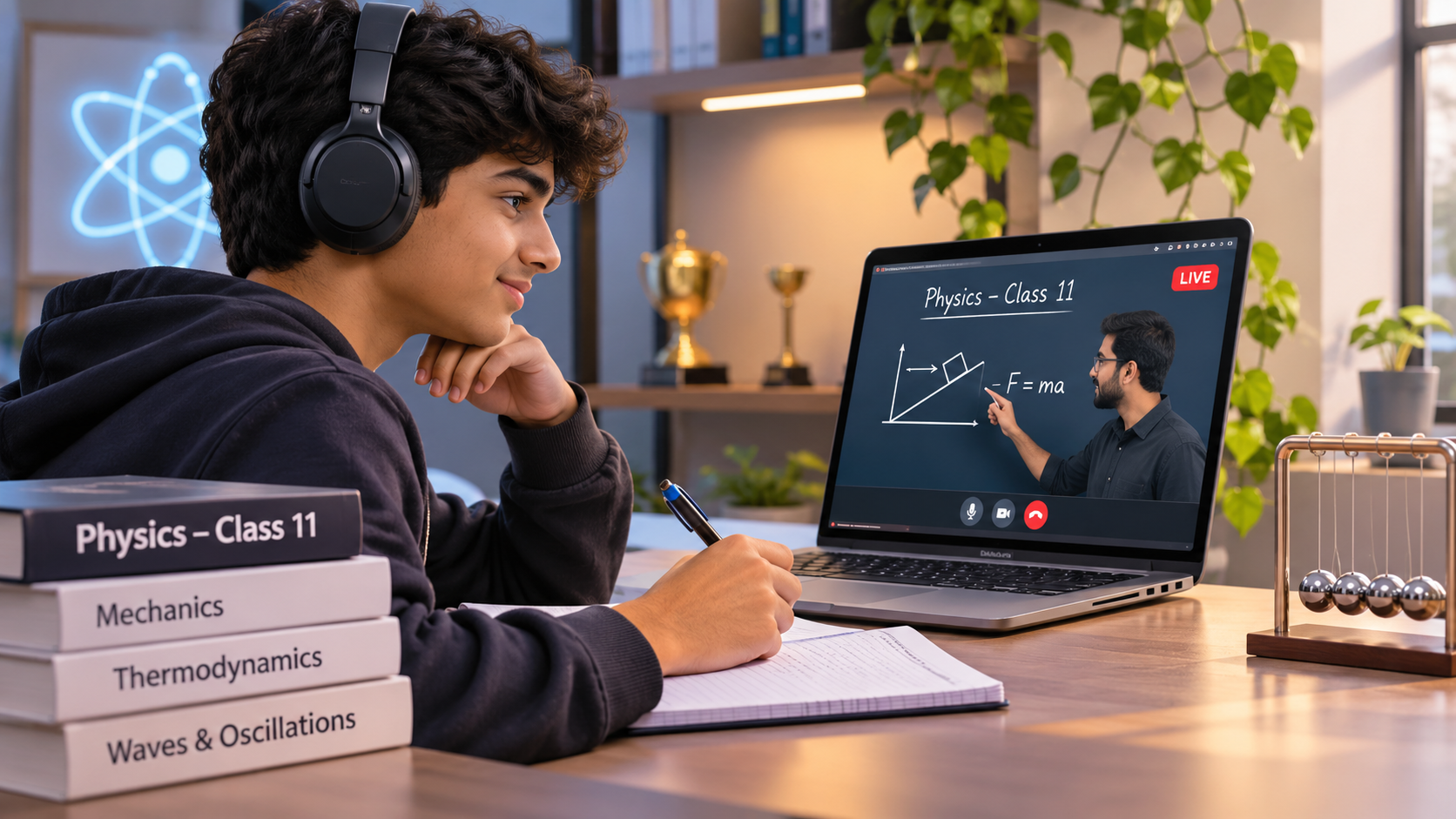
Here's the honest answer: earlier than you probably think. And if it's already mid-November and you haven't started, don't panic. Start this week.
I'll explain why timing matters so much for Class 11 physics, how to tell if you need help, and what a sensible plan looks like. By the end, you'll also know how to test a class before paying a rupee.
Why Class 11 Physics Trips So Many Students Up
Most students walk into Class 11 thinking it'll be a slightly harder version of Class 10. It isn't. Kinematics, Laws of Motion, Work and Energy, Rotational Motion: the jump is big, and it happens in the first few months.
The 2026-27 CBSE scheme has 14 chapters and a 70-mark theory paper. That's a lot of ground, and the chapters lean on each other. Missing the idea of vectors in April and Laws of Motion feels like a foreign language by June.
There's another reason to care. Coaching trackers put the share of JEE and NEET questions that come from Class 11 at around half. Take that as a rough estimate, not an official figure. Even so, it tells you where the marks live.
So, When Should You Start Online Physics Tuition for Class 11?
The sweet spot is the first two months of the session, so April and May for CBSE students. That gives you time to build the basics properly while the syllabus is still light.
Missed it? Join now. The second-best time to begin online physics tuition for Class 11 is today, and I mean that literally, because a doubt in Kinematics never stays in Kinematics. It follows you into every chapter that comes after.
Starting early gives you three things:
- Time to fix weak basics before they pile up
- Room to actually practise numericals instead of only reading theory
- A much calmer Class 12, without the last-minute panic
Five Signs You Should Stop Waiting
Be honest with yourself on this one. How many of these sound like you?
1. You understand the lecture, then freeze the moment a number appears.
2. Your unit test marks keep sliding even though you're studying hard.
3. You copy the solution from the book and tell yourself you'll "get it later".
4. Your doubts keep piling up because there's never time to ask in a crowded school class.
5. You want JEE or NEET, but you haven't taken a single weekly test.
Two or more? That's your cue. These are exactly the gaps that live classes with proper doubt time are built to close.
What If You're Starting Late? A Quick Map
Every window still works. The only thing that changes is how much repair work you'll carry with you.
| When you join | What to do | Why it works |
|---|---|---|
| Before Class 11 starts | Learn vectors, units, and basic graphs | You enter Mechanics ready |
| April to June | Start full online physics tuition for Class 11 | The best window; basics get built right |
| July to September | Join with a catch-up plan | Gaps are still small |
| October to December (you are here) | Join with revision plus new chapters | Enough time to repair before annual exams |
| January onward | Join for annual exam rescue | Class 12 begins in April, so fix it now |
Look at that last column again. No row says "wait and see".
The Syllabus Changed This Year (Check Your Notes)
This bit catches a lot of families off guard. CBSE brought in a fresh Class 11 syllabus for the 2026-27 session, and NCERT updated its textbooks to match. If your child is using a senior's old notes or last year's guidebook, some of it may not line up anymore.
A good teacher running your online physics tuition for Class 11 keeps track of this for you. It sounds boring, but it saves hours every month.
What to Look For Before You Pay Anyone
Not every class is worth the money. Before you sign up, ask:
- Do they teach from the new 2026-27 NCERT first, and only then move to JEE or NEET level?
- Are the classes live, with real-time doubt-clearing during the session?
- Will you get chapter-wise tests and a clear score report?
- Are recordings available if you miss a class?
- Can a parent see progress without chasing anyone for updates?
- Is there a demo class before payment?
If the answer to any of these is no, keep looking. You can compare options on the platform comparison page, and the guide on how to choose a physics teacher walks through the same checks in more detail.
Online or Classroom? Think About the Real Cost
Fee trackers list big Kota classroom programs at roughly ₹1.4 lakh to ₹1.8 lakh a year for 2026-27. That's before hostel and food. Online physics tuition for Class 11 skips the move, the rent and the travel entirely, and you get recordings, so a missed lecture isn't gone for good.
Does online suit everyone? No. It asks for some discipline. If you can stick to a timetable and show up live, it works very well. If you tend to drift, choose a batch with tracked attendance and a weekly check-in with a mentor.
Why Parents Keep Choosing Online Physics Tuition for Class 11
Parents usually want to know one thing first: will my child actually improve?
Online makes progress easier to see. There's a weekly test score, a log of attendance, and a teacher who flags a weak chapter before it becomes a failed unit test. And there's no late-night commute, which matters more than people admit. Your child studies at home, with you nearby.
If you're wondering how teachers get judged, the methodology page explains the criteria in plain language.
Three Mistakes to Avoid Once You've Joined Online Physics Tuition for Class 11
Signing up is the easy part. Using the class well is where students slip.
Watching without solving: It feels productive. It isn't. After every lecture, solve at least ten problems yourself.
Skipping NCERT: Competitive books are useful, but NCERT is the base for boards and NEET. Finish it first.
Sitting on doubts: A doubt you ignore tonight is a bigger problem next month. Ask in class, or message your mentor the same day.
Fix just these three, and you'll see more change than you would from an extra hour of study every day.
What Waiting Actually Costs
Picture a student who skips April and May. By the time they join, Mechanics is two chapters deep. A gap in Kinematics now blocks Laws of Motion, which then blocks Work and Energy. One small hole turns into five.
A teacher finds the first broken link and repairs it. The sooner that happens, the less it costs you in time and marks.
Three Steps to Get Started
1. Book a free demo class: Sit through a live session and judge the teaching style yourself. 2. Share your last unit test: A teacher can spot your weak chapters in a few minutes. 3. Get a weekly plan and begin: Classes, practice sets, and tests, all matched to your syllabus.
Want to see who'll actually be teaching you? Their style, experience, and focus are listed on the teachers page.
One Last Thing
Class 11 is the one year you can't redo. Good online physics tuition for Class 11 turns it into an advantage instead of a scramble. Start while the gaps are still small.
Frequently Asked Questions
Ideally within the first 60 days of the session, which means April to May. If you missed that, start now. A catch-up plan can repair gaps before annual exams.
Not at all. Several months of the session are left, and the break before Class 12 gives you another repair window. Joining now still beats joining after annual exams.
Yes, as long as the teacher builds NCERT first and then adds competitive-level problems. Ask for a plan that covers both before you enrol.
A common setup is live classes plus one to two hours of daily practice. Your teacher should adjust that after your first test.
It does. CBSE introduced a new Class 11 syllabus for 2026-27 with updated NCERT textbooks. Use the new edition and confirm your plan with your tutor.