JEE Main Physics Paper Attempt Strategy: Which Questions to Solve First and How to Manage 60 Minutes
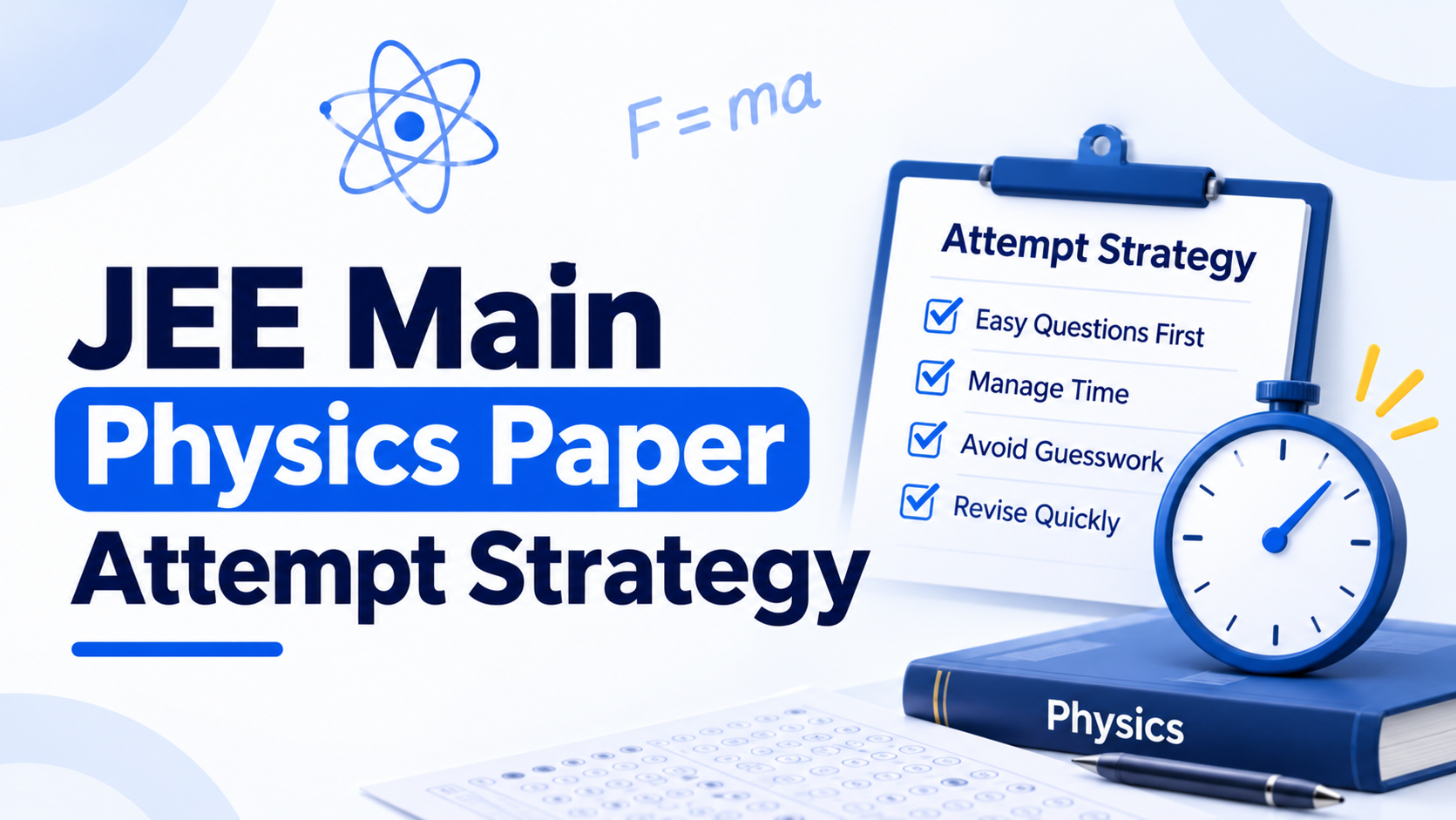
Two students walk into JEE Main with the same preparation. One scores 80 in Physics. The other scores 55. The difference is rarely knowledge. It is how they attempted the paper.
Physics punishes bad attempt order more than any other subject. A single long, calculation-heavy question can eat five minutes and leave you rushing through three easy ones at the end. This guide gives you a clear system: what to solve first, how to split your time, and when to skip.
Pattern check: JEE Main Paper 1 has 75 questions in 3 hours. Each subject has 20 MCQs and 5 numerical-value questions (100 marks per subject). Most sources report +4 for correct and −1 for wrong in both sections, and all 5 numericals are compulsory. Always confirm the final rules in the official NTA bulletin.
First, Understand the Time Reality
There is no separate timer for each subject. You get 3 hours for the whole paper and can move between sections. The "60 minutes per subject" idea is a planning guide, not a rule.
At 25 Physics questions in 60 minutes, you have about 2.4 minutes per question on average. But averages hide the truth: easy questions should take 1 minute, and a hard one may deserve 4. Your job is to spend time where it earns marks.
The 3-Pass Strategy
Do not solve Physics questions from 1 to 25. Solve it in three passes.
Pass 1 (about 30 to 35 minutes): Collect the sure marks
Go through all 25 questions in order. For each one, decide in about 10 seconds:
- Green: You know the method, and it looks short. Solve it now.
- Yellow: You know the method, but it looks long or calculation-heavy. Mark it for review and move on.
- Red: You are unsure how to start. Mark it for review and move on.
The goal of Pass 1 is simple: bank every Green question accurately before touching anything difficult.
Pass 2 (about 15 to 18 minutes): Attack the Yellows
Return to the questions you marked Yellow. These are solvable, just time-expensive. Now that your easy marks are safe, you can spend 3 to 4 minutes on each without panic.
Pass 3 (about 7 to 10 minutes): Reds and review
Look at the Reds. Can you eliminate options in an MCQ? Can you at least set up the problem? If a Red still makes no sense after 90 seconds, leave it. Use any remaining minutes to re-check your Green answers, especially units, signs, and rounding.
Suggested 60-Minute Time Split
| Phase | Time | What you do |
|---|---|---|
| Pass 1 | 30 to 35 min | Solve all Green questions, tag the rest |
| Pass 2 | 15 to 18 min | Solve Yellow questions |
| Pass 3 | 7 to 10 min | Try Reds, eliminate options, re-check answers |
Adjust the split to your own mock-test data. If you finish Pass 1 faster, you have more time for Yellows. The structure matters more than the exact minutes.
Which Questions to Solve First
Not all questions deserve equal time. Here is a simple way to classify them at a glance:
| Question type | How to treat it |
|---|---|
| Direct formula or concept-based | Solve first, aim for under 1.5 minutes |
| Short numerical with clean numbers | Solve in Pass 1 |
| Multi-step calculation with messy numbers | Usually Yellow, do in Pass 2 |
| Multi-concept, long diagram or unfamiliar setup | Usually Red, attempt last |
| Chapters you are strongest in | Prioritise, regardless of position |
Start with the chapters where you are strongest. Confidence early in the paper steadies your hands for the rest.
How to Handle the 5 Numerical Questions
Numericals have no options to guide you, so a small slip gives a wrong integer with nothing to warn you. Three habits help:
1. Convert to SI units first. 2. Keep extra digits during the calculation and round only at the end. 3. Do a quick size estimate to catch power-of-10 errors.
Since numericals carry the same +4 and, per most sources, the same −1, do not rush them. If you have time left, they are the best place to re-check.
Should You Guess?
The maths is worth knowing. With 4 options and +4 / −1 marking, a pure blind guess has a small positive expected value (about +0.25 marks), but it swings wildly and can hurt your score on a bad day.
The smarter rule is to eliminate first, then decide:
- If you can remove 2 options, guessing between the remaining 2 is a good bet (expected value about +1.5).
- If you cannot eliminate anything and have no idea, skipping is reasonable.
- For numericals, there are no options to eliminate, so blind guessing has almost no upside.
5 Mistakes That Waste Physics Time
- Getting stuck on question 3: One stubborn question can cost you three easy ones later. Set a 3-minute alarm in your head.
- Solving in strict order: Question order is not difficulty order.
- Skipping the question's last line: Misreading what is asked wastes a full solution. Underline the asked quantity.
- Doing Physics last because it feels hard: Starting with your strongest subject builds momentum. Decide your subject order in advance, and practise it in mocks.
- No review time: Even 5 minutes of re-checking catches careless errors. Our guide on stopping silly mistakes in JEE Physics shows a quick 3-check method.
How to Practise This Before the Exam
Strategy only works if you rehearse it. In your next mocks:
1. Run the 3 passes on every Physics section and record how many minutes each pass actually takes. 2. After the test, note which questions you tagged wrong (Green that turned out hard, Red that was actually easy). 3. Adjust your tagging until your 10-second judgement is reliable.
To decide which chapters to prioritise within Pass 1, see our chapter-wise weightage analysis for JEE Physics.
When the Problem Is Not Strategy
If your concepts are solid but you still run out of time, look at how you are being trained. Teachers who run timed sessions and analyse your attempt order, not just your answers, build this skill far faster. Our teacher comparison page shows how different teachers approach test analysis and exam strategy.
Frequently Asked Questions
A common planning guide is about 60 minutes per subject, since the paper is 3 hours for three subjects. There is no sectional timer, so adjust to your strengths using mock data.
Start with the subject you are strongest in and most comfortable with, then decide the rest. There is no single correct order, so test your plan in mocks.
There is no fixed number. Leave questions you cannot start or cannot verify, and attempt those where you can eliminate options or finish accurately.
With negative marking, accuracy matters. Attempt every question you can solve confidently first, and treat the rest as bonus marks, not obligations.